Showing posts with label food safety. Show all posts

Sunday, May 13, 2012

What's in a (local) name?

 So on our weekly trip to Meijer this week for groceries, Alyssa and I did our typical stroll through the dairy case for a few items, and to look at food in general (yeah, exciting life I live), when we made this discovery.

Now, at first glance, you say, wow, great, local, Michigan brand cottage cheese!! Finally, I can support a local brand for my cottage cheese needs!!


So, you spin the container around, and you see this....


Ohio, you say!??! What the hell, I thought this was a Michigan product!??! Ohio!??!


So you read down a little further, and you start seeing this plant number codes...

Plant Codes Here ^^^^

So what exactly are plant codes?? Well, my friend, the plant code tells you exactly where the product came from, mainly incase there is ever a recall. But for our purposes, it's going to tell us where the product was made, and most likely, where some of its ingredients came from. In this case, it came from plant 26-330. Using our handy-dandy link to the FDA's website we see that the first numbers, 26, signify a Michigan plant. The second numbers, 330, are the plant code; plant 330 is the Country Fresh plant located in Grand Rapids. This plant uses milk from many of my neighbors, and a lot of milk from West Michigan in general.


Same product, same plant, same milk.

The "Michigan" brand: 3.99

Country Fresh brand: 2.49

Just because the label says where it came from, in this case Ohio, that doesn't mean it actually came from there. When in doubt, check the label, and if you're still unsure, do a little research. The information is out there.

Tuesday, December 13, 2011

Grandpa's Way

Surfing though my twitter feed today, I came upon a great quote from a friend of mine regarding how people who aren't involved in farming or ag today seem to think we should do things the way their grandfather did, on his farm. While my grandfather certainly did teach me a lot of things about farming, there are more than a few things that were common in his day that we've moved beyond. So, before we head down memory lane, let's look at a few common practices in "his day" versus what we're doing now.

Things like...
Used oil. Grandpa used to dump it in the driveway "to keep the dust down". Today, we recycle it, along with batteries, chemical jugs, and trash. Grandpa's solution was "the dump".

Spray programs. Grandpa used to spray atrazine on corn by the gallon, and used chemicals in the orchard that killed every bug in the township. Today, we are using lower pesticide rates than ever before, and integrated pest management has changed how we manage orchards.

Conservation. Grandpa would plow, disk, and drag the soil into a powder, then plant the corn. We've been using no-till farming since the early 1990's, and have installed filter strips and wildlife habitat area around the farms. Stewardship is a major concern.

So, as you can see, sometimes the "good ol' days" aren't so great. Farming has changed dramatically, but not always for the worse. So, before you criticize what we do, try to learn why we are doing it first.

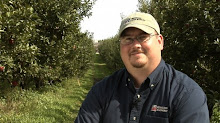
Jeff VanderWerff is a 4th generation farmer from Sparta, Michigan. Learn more about his family farm at www.youtube.com/agsalesman


Tuesday, August 23, 2011

Apple harvest brings new challanges

Well, it's that time of year, time for the days to shorten, the air to chill, and the apples to come off the trees. Growing up in an area of fruit production, I guess I've always known how apples were picked, and generally assumed that most farmer knew as well; boy was I wrong! Sitting here at the AgChat Foundation Conference, I'm amazed that I've needed to explain several times now to people just how dependent of migrant labor we really are. Even other farmers didn't realize that apples are harvested by hand, one by one.

In order to harvest apples correctly, we depend on migrant labor, and they are far more than just employees to us; they are a valued part of our team. We can do everything right, all year, and if we don't have skilled, efficient, workers to harvest our crop, it's all for naught. I guess this is why it's so disheartening to hear the discourse regarding migrant labor and immigration. Now, I'm the great-grandson of dutch immigrants; we waited in line like everybody else. However, we need to get real with this problem. Migrant labor is a vital part of, quite honestly, our national security, and we need to realize that.

Now, I'm not advocating a free pass; but right now, we have bigger problems in this country than this, and quite honestly, we could use the money (tax revenue). Secure the border, bring these people out of the shadows, and make them start paying taxes; they are already benefitting from our social system, we might as well get some money out of it.

Our country needs a secure food supply. Consumer demand is asking for more and more fresh fruits and vegetables, and we need to have them raised by our standards, on our land. Support common sense immigration reform, and remember, your next meal may depend on it!

Thursday, June 2, 2011

Safest food on the planet, now at lower temperatures!

Hopefully, you were able to enjoy the great weather this past memorial day weekend, and while you were waiting for some tasty cuts of pork or beef to come hot of the grill, you took the time to remember the brave American soldiers who paid the ultimate price to allow us such great freedom. I have nothing but absolute respect and admiration for those men and women, and I must say, I feel a little guilty bringing this up. However, in addition to thanking those brave souls for our freedom, we can also thank the American farmer who helped bring us that meal, and provided us with the safest food on the planet.


Last week, the USDA released a statement telling us something that many farmer have known for years; that it is perfectly safe to cook pork to medium, at 145 degrees internal temperature. This announcement is great news for consumers, and reinforces a basic truth about our food: that it is truly safe, and that modern farming practices have contributed to it. For example, years ago, people were leery of pork, especially under-cooked pork, for many good reasons. The pigs lived outside, basically running loose, eating whatever happened to appear in front of them (I won’t get into details). Today, pigs live comfortably inside clean, well-lit, climate controlled barns; which are probably a lot cooler than my old farmhouse right now. The pork is harvested and processed in state-of-the-art facilities, which are cleaned, scrubbed, and inspected daily within an inch of their lives. The USDA and its watchful eye are never more than a stones throw away, providing guidance and oversight to the industry.


But outside of the processing world, pork farmers are doing the right things as well. Large and small alike, most farmers today are PQA+ Certified, meaning they have taken part in a voluntary program that holds them to a higher standard, and helps them produce a better product.


Farmers today care more about food and consumer safety than ever. As a farmer, it kills me to see a recall, or hear about people getting sick from a food-borne illness, because I feel like I have somehow failed. You depend on me for safe food the same as you would depend on a fireman to come save your house in a fire. We all have a job to do, and we want to do it well. From soldiers to farmers, we’re all working to protect American consumers.


Jeff Vander Werff is a 4th generation farmer from Sparta, Michigan. Learn more about how safe your food really is at www.youtube.com/agsalesman